


Brand marketing vs performance marketing: why organisations need both
By Ann-Marie Reacord
Brand marketing and performance marketing are often treated as opposites. They are not.
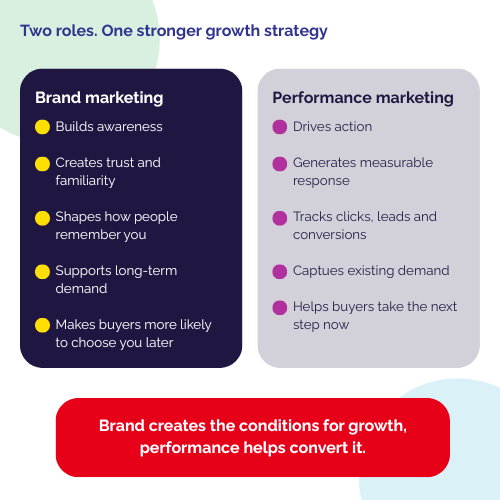
In many organisations, marketing activity gets divided into two camps. Brand marketing is seen as the long-term work: building awareness, reputation, trust and emotional connection. Performance marketing is seen as the commercial engine: generating leads, driving conversions and producing measurable results.
The problem is that when these two disciplines are treated separately, organisations often end up with an imbalance. They either invest heavily in brand but struggle to connect that work to commercial outcomes, or they focus almost entirely on short-term performance and gradually weaken the very thing that makes people want to choose them.
The strongest marketing strategies do both. They build the brand so the organisation becomes known, understood and trusted, and they use performance activity to convert that trust into action.
What is brand marketing?
Brand marketing is the work that shapes how people understand, remember and feel about your organisation. It is not just your logo, tone of voice or visual identity, although those things matter. It is the strategic work of defining what you stand for, who you are for, what makes you different and why people should believe in you.
Good brand marketing builds familiarity over time. It helps people recognise your business before they are actively ready to buy. It creates meaning around your expertise, your values and your approach. In B2B sectors, particularly those with long buying cycles, complex stakeholder groups and relationship-led decision-making, that matters enormously.
A buyer may not be ready to speak to you today. But if they have repeatedly seen useful, relevant and distinctive thinking from your organisation, you are more likely to be remembered when a need arises. Brand marketing does not always create an immediate click or enquiry, but it creates the conditions that make future decisions easier.
What is performance marketing?
Performance marketing is activity designed to generate a measurable response. That might include paid search, paid social, email campaigns, landing pages, lead generation campaigns, retargeting, conversion optimisation or direct response activity.
Its strength is that it is easier to track. You can measure clicks, conversions, cost per lead, form fills, bookings, downloads and sales activity. For marketing leaders under pressure to prove impact, this is valuable. Performance marketing can show what is working, where attention is coming from and how efficiently budget is being used.
But performance marketing works best when there is already trust, relevance and clarity in the market. If people do not understand your offer, do not recognise your name, or cannot see why you are different, even the most carefully optimised campaign will have limits.
Why performance marketing struggles without brand
A common mistake is to assume that if a campaign is not converting, the answer is to adjust the targeting, change the creative, increase the budget or rewrite the call to action. Sometimes that is true. Often, the issue sits deeper.
If the brand is unclear, performance marketing has to work too hard. It has to introduce the organisation, explain the value, build trust, answer objections and prompt action all at once. That is a lot to ask from one ad, one landing page or one email.
This is why organisations can spend more and more on lead generation while seeing diminishing returns. They are trying to harvest demand without having invested enough in creating it. People may click, but they do not convert. They may recognise the service, but not the difference. They may understand the offer, but not yet trust the organisation behind it.
Brand marketing makes performance marketing more effective because it gives people a reason to pay attention before they are asked to act.
Why brand marketing needs performance
The opposite problem also exists. Some organisations invest in brand awareness, thought leadership and reputation-building but do not create clear routes for people to engage.
They produce interesting content but do not guide the next step. They build a stronger presence but do not connect it to audience journeys. They develop a compelling narrative but do not turn it into campaigns, propositions, landing pages or sales conversations.
Brand without performance can become too passive. It creates interest, but not enough momentum. It may make people feel positively about the organisation, but fail to help them move from awareness to enquiry, conversation or decision.
Performance marketing gives brand activity structure. It helps organisations understand what is resonating, where demand is emerging and which messages are moving people closer to action.
The two work together across the buyer journey
In B2B marketing, buyers rarely move neatly from awareness to purchase. They read, compare, ask colleagues, attend events, search online, view LinkedIn profiles, visit websites, speak to peers and return to content over time. Different stakeholders may enter the process at different moments, each with different questions and concerns.
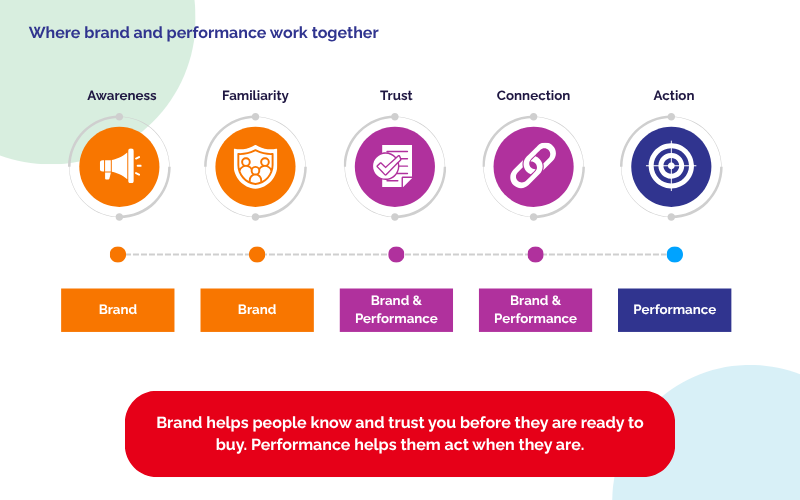
Brand marketing helps you become known before the need is urgent. It builds recognition, trust and relevance. Performance marketing helps you respond when intent increases, giving people useful ways to take the next step.
A thought leadership article may not generate a lead on the day it is published, but it may shape how a buyer understands a problem. A LinkedIn post may not result in an immediate enquiry, but it may make your organisation more familiar. A paid campaign may then perform better because the audience has already encountered your thinking elsewhere.
The impact comes from connection, not isolation.
Why this matters more now
The distinction between brand and performance is becoming even more important as search, social and AI-driven discovery change the way people find information.
Zero-click search means people may see your brand, your expertise or your point of view without ever visiting your website. AI-generated answers may summarise your content before someone clicks through. LinkedIn posts, newsletters, articles, videos and search results all contribute to how your organisation is understood.
This makes brand consistency critical. If your positioning is unclear, if your messages vary from channel to channel, or if your content does not build around a clear area of expertise, you are harder to remember and easier to replace.
At the same time, marketing teams still need to show commercial value. Performance remains essential. But the performance activity that works best will usually be supported by a strong brand foundation.
The danger of over-investing in one side
Too much focus on performance can make marketing feel reactive. The team becomes preoccupied with immediate metrics, short-term campaigns and constant optimisation. Over time, the brand can become weaker because all communication is designed to convert rather than build meaning.
Too much focus on brand, without enough attention to conversion and measurement, can make marketing feel disconnected from commercial reality. The work may be thoughtful and creative, but it becomes harder to prove how it supports growth.
The balance will look different for every organisation. An early-stage founder may need brand clarity before investing heavily in demand generation. An established business may need performance activity to activate a strong but underused reputation. A construction or built environment business may need brand marketing to build trust before the brief lands, then performance-led content and campaigns to support conversion once an opportunity emerges.
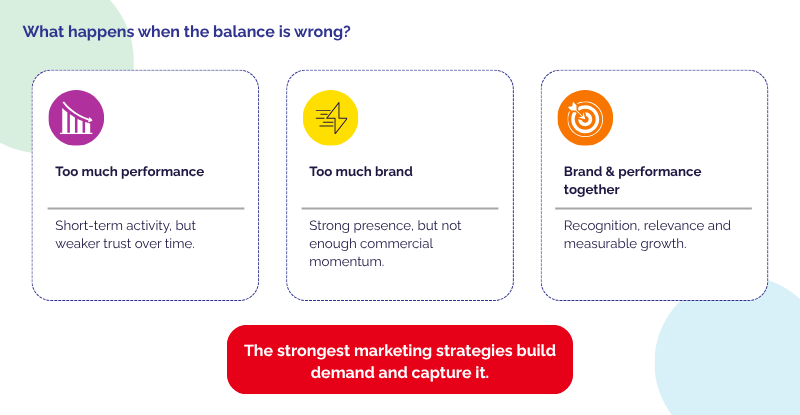
The important point is not to choose one over the other. It is to understand the role each plays.
How to bring brand and performance together
The first step is to make sure the brand foundations are clear. That means having a shared understanding of your positioning, audience, value proposition, proof points and messaging hierarchy. If these are not agreed, performance marketing will quickly expose the gaps.
The second step is to map the buyer journey properly. Who needs to know you before an opportunity appears? What questions are they asking at different stages? What evidence do they need? Where do they go for information? What might stop them moving forward?
The third step is to connect content and campaigns to that journey. Some activity should build trust and familiarity. Some should educate and clarify. Some should create opportunities for direct engagement. Some should convert existing demand.
Finally, measure both short-term and long-term indicators. Leads, enquiries and conversions matter, but so do branded search, engagement from target accounts, newsletter growth, content saves, event attendance, repeat website visits and the quality of conversations created.
The real question
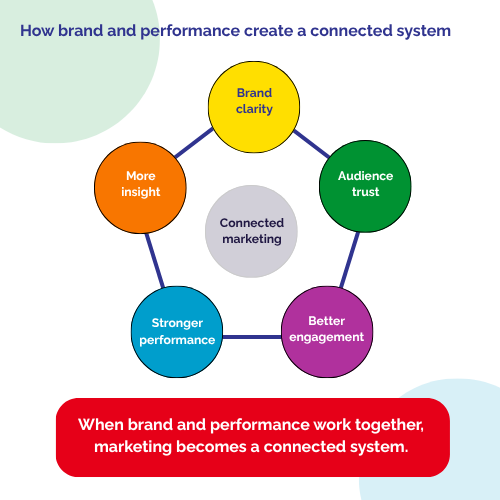
The question is not whether brand marketing or performance marketing matters more. The real question is whether they are working together.
Brand marketing makes people more likely to know you, understand you and trust you. Performance marketing makes it easier for them to act when the time is right.
One builds the conditions for growth. The other helps capture it.
Organisations that understand this balance are less likely to chase activity for its own sake. They are more likely to build marketing that creates recognition, relevance and results.
At The Listening People, we help organisations build marketing strategies that connect long-term brand clarity with measurable commercial activity. Our approach begins with listening, to your market, your clients and your internal teams, so we can understand how your organisation is perceived, where your positioning needs to be strengthened and how your brand and performance activity can work harder together. If you want marketing that builds trust, creates demand and gives people a clear reason to act, we’d be happy to start the conversation.
FAQs
1. What is the difference between brand marketing and performance marketing?
Brand marketing focuses on building awareness, recognition, trust and preference over time. It helps people understand who you are, what you stand for and why they should consider you. Performance marketing is focused on measurable actions, such as clicks, enquiries, downloads, bookings, leads or sales. Brand marketing builds the conditions for future demand. Performance marketing helps capture and convert demand when people are ready to act.
2. Why do organisations need both brand marketing and performance marketing?
Organisations need both because each plays a different role in growth. Brand marketing makes people more likely to know, remember and trust your organisation. Performance marketing gives those people a clear route to take action. When the two work together, marketing becomes more effective because campaigns are supported by stronger recognition, clearer positioning and greater trust.
3. Can performance marketing work without brand marketing?
Performance marketing can generate short-term results without strong brand marketing, but it often becomes less effective over time. If people do not recognise your organisation, understand your value or trust your expertise, campaigns have to work much harder to convert. Strong brand marketing makes performance activity more efficient by increasing familiarity, credibility and relevance before someone clicks or enquires.
4. Is brand marketing measurable?
Yes, brand marketing is measurable, but not always through the same metrics used for performance campaigns. Useful brand marketing indicators include branded search growth, direct website traffic, share of voice, social engagement from target audiences, newsletter subscribers, event attendance, content saves, repeat website visits, referral quality and the strength of sales conversations. The key is to measure both short-term activity and longer-term indicators of trust, recognition and preference.
5. How should B2B organisations balance brand and performance marketing?
B2B organisations should balance brand and performance marketing by mapping the full buyer journey. Brand activity should build awareness, trust and authority before buyers are ready to engage. Performance activity should support conversion when interest or intent increases. The right balance depends on the organisation’s maturity, market position, buying cycle and commercial goals, but both should be connected through clear positioning, audience insight and a consistent value proposition.